Showing posts with label health. Show all posts

Tuesday, May 28, 2013

SUFFERING IN SILENCE: Female Sexual Dysfunction (Part I)

By Rachel Hercman

Rachel Hercman, LCSW is a psychotherapist specializing in relationships.  She works at the Medical Center for Female Sexuality in New York (www.centerforfemalesexuality.com), a center that provides cutting-edge medical and psychological treatment for female sexual dysfunction, where she helps women improve their body image, sexual functioning, and relationship satisfaction.  She can be reached at Rachel@centerforfemalesexuality.com


For a married woman, the ripple effect of vaginismus can exceed beyond just the bedroom.


SUFFERING IN SILENCE: 
Female Sexual Dysfunction 
PART I


Sara* was a beaming, exuberant bride.

After all those hopeless Shidduch dates, meeting Dovid* was the answer to her fervent prayers and she was overwhelmed with gratitude at how much they connected. He was truly worth the wait.

The wedding was everything she dreamed of, plus more. But as Sara and Dovid joyfully left the hall to go to a nearby hotel, some fears started creeping up. Though Kallah classes had been inspiring and her Kallah teacher was open and understanding, Sara had typical wedding night jitters when she thought about developing a sexual relationship. However, she found comfort in knowing that Dovid had a very gentle personality and always had her feelings in mind. Moreover, many of her married friends said they had had similar jitters about the wedding night, and since they became pregnant soon after their weddings Sara presumed that their experiences with the infamous ‘first time’ were a gateway to something better.

Unfortunately, Sara’s ‘first time’ became the start of many attempts to have a ‘first time’. Dovid called his Rav after Sheva Brachos to discuss their inability to consummate the marriage due to feeling like he was ‘hitting a wall’. After an extensive conversation, his Rav surmised that Sara’s vaginal muscles were too tight and he recommended that she take baths, practice relaxation exercises, and drink a glass of wine before intercourse. “Don’t worry”, he kept reassuring Dovid, “plenty of couples have this issue and with time it will correct itself”. But the weeks turned into months, then years, and Sara and Dovid felt like their entire relationship was stunted from reaching its full potential.

Dovid was loving and kind, but Sara felt alone and broken. She didn’t feel comfortable confiding in her mother about her sexual challenges and she was too embarrassed to call her Kallah teacher. After all, she felt like she failed as a student. She was taught that initially sex can be painful, but that with time it would evolve into an enjoyable, spiritual part of her marriage. When that didn’t happen, she began to feel like something was very wrong with her, and it only got worse when she would attend Simchas and feel curious eyes scanning her stomach.

If only she could get over this hurdle, she prayed, she could feel like a normal person…..

*Names and small details have been changed to maintain anonymity
____________________________________________________________

Meet vaginismus, a type of female sexual dysfunction that contrary to popular belief, is not ‘all in your head’. Vaginismus is a condition in which the vaginal muscles involuntarily contract, making penetration painful and sometimes impossible. In its mildest form, a woman can tolerate penetration for very short periods, but it's unpleasant and painful. Or it can be so severe that she can't even touch herself near her vagina, can't have a gynecological exam, and can't insert a tampon because the pain is so intense and the fear so great.

In cases of primary vaginismus, a woman has never been able to have penetrative sex or experience vaginal penetration without pain. Secondary vaginismus occurs when a woman who has previously been able to achieve penetration develops vaginismus, and this may be due to (but not limited to) physical causes such as childbirth, infection, cancer, or even menopause. In both primary and secondary cases of vaginismus, the physiological and psychological factors are not only relevant but can sometimes play off each other, leading to exacerbation of symptoms. Thus, when a woman suspects that she may be suffering from vaginismus, it is essential that she have a comprehensive assessment that takes into account her emotional and physical symptomology. (For more information on vaginismus and painful intercourse click here.)

Suffering from vaginismus is painful from all perspectives; physically, psychologically, religiously, and socially. Here at the Medical Center for Female Sexuality, we often meet strong, successful women who share the heartbreaking feeling of being “broken”, “defective”, or “less of a woman” because of their vaginismus. As seen in Sara’s case, our patients with vaginismus often reflect on their suffering as casting a dark shadow not only on the marriage, but on their whole self-concept and identity. Feelings of inadequacy, incompetence, and isolation are commonly reported, and with time these feelings often intensify if the vaginismus is not treated.

For a married woman, the ripple effect of vaginismus can exceed beyond just the bedroom. For some husbands, the notion of ‘inflicting’ pain on their wives via intercourse is so upsetting that it can affect their own confidence and sexual functioning, and distance may ensue as both spouses associate their sex life with pain and negativity. Many couples we treat will share that they have become less physically affectionate altogether; the other day a patient tearfully shared that at this point in her marriage, she won’t even hug or kiss her husband and she feels terrible for it. She knows it hurts her husband and makes him feel unwanted and unloved, but she is scared that touching him may send the wrong message that she is interested in having sex. For this couple, as well as so many others we treat, they have adapted to the sexual dysfunction by living like roommates; respectful to each other, set in a familiar routine, but feeling a significant void.
  
Fortunately, there is wonderfully effective treatment for vaginismus, but many women do not end up getting the appropriate help until significant time has passed and the emotional pain is that much greater. Because vaginismus is often a private struggle, many of our patients breathe a sigh of relief upon learning that they are not alone in their suffering, it’s not all in their head, and there is hope in eliminating the pain.

In Sara’s case, a problem that went on for years was able to be rectified in just a few months and she was able to finally enjoy the sexual connection that her marriage had longed for.  While it took some time to adjust to having a sexual relationship after being so accustomed to its absence, Sara felt a surge of unprecedented optimism.  After years of isolation, she felt reinvigorated in her whole outlook on life.  She felt excited about her relationship with Dovid. She could smile as she looked ahead to their hopes and dreams for their future together.  And she could finally feel comfortable with her body and its wonders.

In our next article, we will be exploring some of sociological, cultural, and Halachic factors that come up for frum women suffering from sexual dysfunction.

Monday, March 18, 2013

Defying Gravity: What My Miscarriages Taught Me

By Jessica Hoffman
Jessica, Geshem City Editor and Blogger, is a native Jewish Seattleite. She has contributed her writing to Kveller, Real Time, BBC World News, JOFA Journal, Jewneric, Bangitout, NW Beauty Magazine, and more. Jessica and her husband Ari run Seattle NCSY and raise their 3 children in the Seward Park community. Balancing her writing career with Jewish outreach and being a SAHM is a continuing challenge she faces with eternal optimism.


 I covered it up on the outside so I could cover it up forever. I tried to allow my natural pragmatic nature to smoothly slide me past this phase in my life so I could go on to have more healthy pregnancies.

Defying Gravity: What My Miscarriages Taught Me 

“Just remember, your body knows what it can handle.” My father said this to me when I told him I was pregnant with my first child. I don’t know how he knew. Perhaps some premonition…but he knew. I internalized this wisdom and, at my first ultrasound, stared shocked at the screen when the letters “A” and “B” popped up.

“Um, twins?” I asked the ultrasound technician. My father is a prophet! I thought. And my husband had said over and over again that he would love for us to have twins. She smiled at me warmly and said, “Not exactly.” We looked at the screen together. She pointed at the “A” so I could see the life growing inside the sac. Then she pointed at the black emptiness next to the “B” and explained, “It was twins, but not anymore. Don’t worry. The remaining baby will most likely absorb the sac. It’s actually great nutrition.”

We both looked over at my husband, whose skin had turned grey, something I recognized as a problem because I myself am a bit of a fainter. He sat down and put his head between his knees. I couldn’t believe it. I’m the fainter and he’s the one trying not to hit the floor? Maybe I should have helped him internalize my father’s advice, too.

It’s this pragmatism, this unemotional response, which is probably the reason I was so emotional when I had a miscarriage with my second pregnancy. When the doctor told me my HCG levels were doubling too quickly, she said it was either twins or my body was about to have a miscarriage. I assumed it was twins again. Nowhere inside my head or my heart did I ever consider that it might be the latter. And when the ultrasound confirmed the miscarriage, and it was all over a week later, I didn’t talk about it…to anyone. I didn’t talk to my husband. I didn’t talk to my parents or my sisters. They all assumed I was over it. And why wouldn’t they? When my best friend saw me bent over with cramps, I told her I had the stomach flu. I covered it up on the outside so I could cover it up forever. I tried to allow my natural pragmatic nature to smoothly slide me past this phase in my life so I could go on to have more healthy pregnancies. “My body knows what it can handle,” I said to myself. “And my body knew this pregnancy would have been bad for me, or the baby would have been unhealthy.” I tried to rationalize my way past it.

It wasn’t until a few days after my post-miscarriage mikvah appointment that “Defying Gravity” from Wicked queued up on my playlist. When the music intensified and Idina Menzel as Elphaba burst into; “So if they care to find me, look to the Western sky. As someone told me lately, everyone deserves a chance to fly,” I burst into tears. (While singing along, of course.) It was so therapeutic that I played it again. I put that song on repeat and it played in my car for days. My toddler son knew all the words, which is when I realized it was time to play something else.

After my second son was born, my husband overheard me telling my Wicked therapy story to a friend who had a miscarriage. He looked surprised and sad. “You cried alone in your car?” he asked me. “For days,” I answered. If only I had remembered that my father’s sage wisdom wasn’t about being practical or emotionless. It was about beetachon…having faith. You can give yourself permission to feel sad, to accept pity when you deserve it, and to be comforted. Trusting your body’s decisions is about acceptance and faith, not about trying to sidle past things emotion-free. My father was giving me a guide toward acceptance, not a shortcut past it.

The third occasion was a combination of both situations. I was pregnant, and before my first ultrasound, I experienced what I was sure was a miscarriage. I was bleeding profusely, and desperate for an answer. The nurse told me over the phone that I was most likely having a miscarriage and I could take a hot bath when the bleeding stopped. In the meantime, she wanted me to come in so they could do a blood draw and confirm that my HCG levels were going down at a normal and predictable rate. I went in, got blood drawn, and went home for a bath. Three days later they called me. It was a new nurse this time. “Congratulations, your HCG levels are multiplying nicely,” she said with a sweet and congratulatory voice.

“There must be some misunderstanding,” I said. “I just had a miscarriage three days ago.” It was Friday, three hours until Shabbos, and she had me come in for an ultrasound. Lo and behold, there on the screen was a perfectly healthy new baby! They told me I’d lost a twin. Again. This time I had a healthy combination of relief, sadness, and joy. And I made a decision, then and there, to talk about it. I look at my three beautiful and healthy children, two boys and a girl, and I wonder what the other three children would have been. I do it out loud, so my husband knows it’s on my mind. I talk about it with friends so they know they can talk to me if it happens to them. We all need to have beetachon—but know that we’re human, too.


Wednesday, December 26, 2012

[Debunking Healthy Food Myths] Myth #3: Healthy food is SO hard to make. Waaaah!


By Shaina Kamman
Shaina is a Board Certified Health Coach. She works with mothers and others who are hungry for change and ready to make healthy food the staple in their home. She is a graduate of the Institute for Integrative Nutrition, the world’s largest nutrition school, and she is also a member of the American Association of Drugless Practitioners and the Weston A Price Foundation.
Myth #3: Healthy Food is SO Hard to Make. Waaaah!

The actual myth goes something like this: Healthy foods are SO hard to make because they are so terribly time-consuming. I will never be able to be both sane and healthy! Waah.

This, of course, is not the truth of the matter. The truth is that potchke foods are terribly time-consuming to make, and can easily wear down your sanity. Foods that necessitate a lot of peeling, chopping, sautéing, and/or many different pots, pans, bowls, and utensils are potchke foods. There is nothing about healthy foods that mandates you making a large mess, or spend a lot of time in your kitchen. 

Healthy foods made with simple ingredients can be prepared in a snap. Today’s simple example is scrambled eggs served with sliced tomato.

Crack the eggs. If you keep kosher -or you are just grossed out by blood spots- check for blood spots. If all is free and clear, go ahead and scramble it up with a fork. Pour it into a preheated pan with butter. WHAT? The crowd gasps. Yes, butter. Just like your great-grandmother used. Scramble it all around until it’s as soft and mushy, or as hard, as you like it. Plop it on a plate next to some tomato slices. Salt and pepper to taste, and voil`a. The breakfast of champions.
Why, you ask? Why is this the breakfast of champions?

Let’s see. Eggs. Incredible, edible eggs. Good quality eggs are rich in just about every nutrient we’ve discovered, especially Vitamins A and D. They have sulphur-containing proteins, which are necessary for the integrity of cell membranes, and contain amino acids tryptophan and methionine that promote a healthy nervous system and good moods! Waah no more. Egg yolk is the most concentrated source of a B Vitamin called choline that we know of. Regarding minerals, eggs are an outstanding source of “heme” iron, which is one of the most absorbable forms of iron. They also provide calcium, phosphorus, and trace minerals. Overall, chicken eggs are considered to be the “most complete” protein source in a single food. In fact, the amino acid profile in an egg is so well proportioned that eggs are used as the reference point in judging the protein quality of other foods.

Butter. It’s bettah with buttah. Good quality butter is a wonderful source of fat-soluble Vitamins A and D, and they are in a most absorbable form. Because of this, in many primitive cultures, butter from grass-fed cows is prized for being especially beneficial for children and expectant mothers. These fat-soluble vitamins found so abundantly in butter act as a catalyst for mineral absorption. Without them, our body is not able to utilize the minerals we ingest, even if they are present in abundance. They are essential for growth, for healthy bones, and for the proper development of our nervous system and brain. Many studies show that butterfat is crucial in maintaining normal reproductive powers, as it is rich in Vitamin E, a precursor for sex hormones.

Tomatoes provide Vitamin C, carotenoids, B-Complex, potassium, magnesium, phosphorus, and calcium. Along with other red fruits, tomatoes are a wonderful source of lycopene, which is valuable in protecting us from cancer.

Now, the recipes I’ve shared in this little mini-series are not exactly earth-shatteringly unique. They are intentionally very basic and simple. Preparing body-building, brain-building, good-mood-supporting, and delicious food for your family is practical, relatively easy, and valuable goal for every home-makin’ Priestess.

Myth #3 has been debunked!

----------

For more information on Shaina’s Health Coaching practice visit www.lifewithin.info and LIKE Life Within on facebook at facebook.com/pages/The-Life-Within/476284052385632 Considering if Shaina’s program is the right fit for you? Mention this LadyMama article for a 10% discount on your initial consultation!


Tuesday, November 27, 2012

LUNCHES MAKE ME CRINGE: The search for healthier lunches on a budget

By Becky Brownstein 
Becky Brownstein is a  wife, mother of five, cleaning lady, chef, program/trip organizer, taxi driver, blogger and all around great gal that lives in Kingston, Pennsylvania. Visit her website at http://spitsgiggles.blogspot.com where she shares all her experiences as a mother with the motto, "When all else fails, laugh!" 

LUNCHES MAKE ME CRINGE: 
The search for healthier lunches on a budget
(+ 4 lunch ideas you should try!)


Lunches. Uch... Just the word alone makes me cringe. It’s the last chore of the night (on a good night) and it’s the hardest. Especially when the cupboards are running low. As soon as you start chucking cereal in a bag, you know it’s time to go to the store.


Last school year I made it my own “Mother-Mission” to make healthier lunches without going over my food budget. I also wanted to get rid of the guilt of spending money on baggies that just get tossed out without a second glance. When I keep to a budget, I have to keep everything in mind. With my budget in mind and with the idea of not over-using baggies, I set out to look for a reusable container that would make that possible.

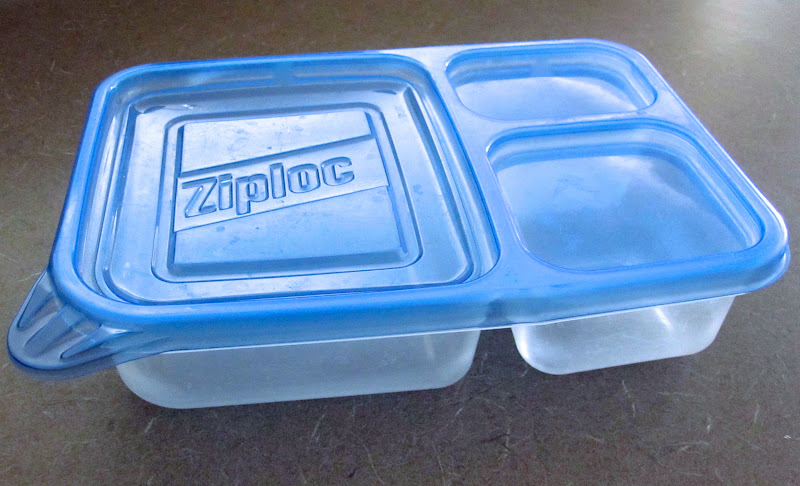
I found these sectioned ziploc containers.

They held up for a few months so I had to replace them in the middle of the year plus, they leaked. A lot. I spent a lot of time saran wrapping the apple sauce inside one of the sections. But it still didn’t cost as much as an actual apple sauce to go cup. Plus, it was one container to clean and it was durable. But the con’s outweighed the pro’s, so this school year I set out to spend a little more money and get something better.

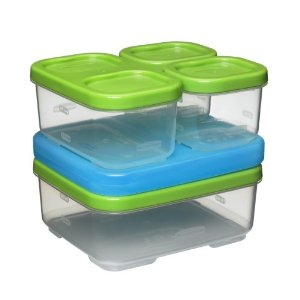
I found this Rubbermaid lunchblox kit.
That blue thing in the middle is an ice pack. They are durable, easily washable, sparkle when they are clean and look really cute. The kids like them better since they can grab one container to take out to recess.  A few of the con’s are It’s easier for the kids to lose lids or misplace them.
The lids also have potential to get yucky stuff trapped so you have to make sure to clean those out well. I also have so many little containers to wash. But it beats saran wrapping. I fill up a sink tub with hot soapy water and either me or the kids will chuck the containers inside.

I mainly use the Lunchblox kit for the fresh fruit and vegetables. I use smaller ziploc containers for the carb snacks. I have 1 box of sandwich baggies for the times I must use them (usually for half a cucumber or tomato), or the times my kids ask for extra snacks, but other than those few times, I don’t use them.

When making lunches I try to think of healthy foods that I know my kids will like, not what I hope they’ll like. I usually ask them “will you guys eat green beans if they were in your lunch?” Either they will answer excitedly or look at me like I was insane and yell “no way!” I also try to keep things the same for everyone. If I know all the kids will eat grapes, I’ll put grapes. But if two kids don’t like bananas, I won’t put bananas at all. But if it’s only one kid who has an aversion to that specific food I’ll make an exception. If I had to make different things for everyone, it would make things really hard for me. Plus, there is a greater chance for mess ups.

One time my daughter came home with two full containers of applesauce and said to me “I don’t even like applesauce!” Shortly after, my husband came home and said “I would like to speak with your quality control department please.” He came home with one full container of grapes. He ate the other. So yeah, mess ups happen. Especially because it’s the last chore of the night. Don’t judge!

Now the fun part!

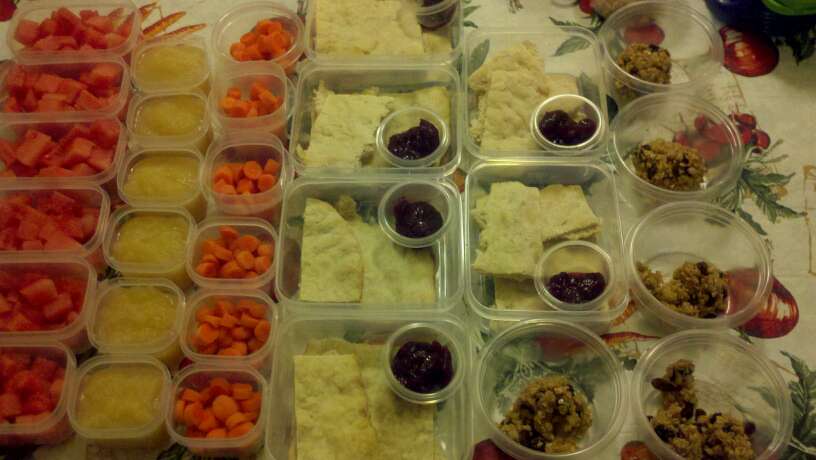
LUNCH #1

For the main dish I made flat bread (easiest and quickest to make when I didn’t have a chance to get bread) with a small cup of jelly for dipping. Next to that is homemade granola that the kids LOVED. Then it’s cut up baby carrots, applesauce and cut up watermelon.


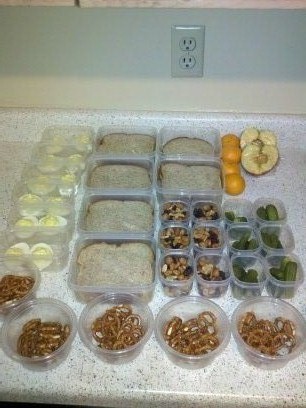
LUNCH #2


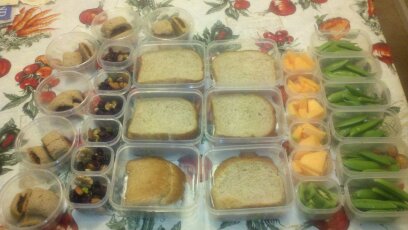
The main dish is tomato, cucumber and lettuce sandwich with a a little bit of mayo. The sides are dried fruit and nuts, pickles, deviled eggs, pretzels and a clementine or half an apple.

LUNCH #3

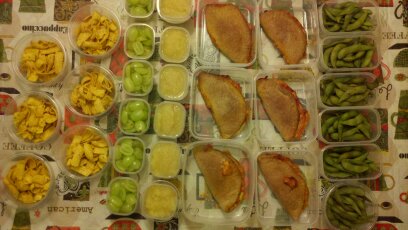
The main dish is a pizza pocket. (I take frozen dinner rolls out while I make dinner and let them defrost/rise until I am ready to make lunches. I then shape them into round circles, add sauce, cheese and mushrooms or olives and bake.) The sides are edamame beans, applesauce, grapes and corn chips.


Lunch #4 

The main dish is a cream cheese sandwich. Not that exciting but the kids could eat those every day. The sides are sugar snap peas, cantaloupe (one is kiwi since my oldest hates cantaloupe) dried fruit and nuts and homemade date bars. (It was my first attempt at these whole wheat bars and I had to agree with my kids that they sucked. I will not be making those again.)


These are just a few examples. I juggle things around, switch around the vegetable options and try to pick things my kids will like. I am not a dietician or a crazy health nut. I just know my kids and know their reaction to overloads of sugar. They crash. Big time! Plus, if I give them sweets as snacks, they are hungry not even an hour later and come home with crazy stomach pains. I used to send them with store bought granola bars but they didn’t feel well after. 


After starting to make lunches like these, my kids have been coming home with empty containers and started requesting healthy snacks first when they are home without even realizing it. Because of that I don’t buy a lot of the snacks I used to. It’s a lot healthier and makes them a lot happier. Sugar treats have become just that, treats.

Monday, July 16, 2012

[Debunking Healthy Food Myths] Myth #2: Healthy Food Costs an Arm and a Leg

By Shaina Kamman
Shaina is a Board Certified Health Coach. She works with mothers and others who are hungry for change and ready to make healthy food the staple in their home. She is a graduate of the Institute for Integrative Nutrition, the world’s largest nutrition school, and she is also a member of the American Association of Drugless Practitioners and the Weston A Price Foundation.


DEBUNKING HEALTHY FOOD MYTHS
With Shaina Kamman


Myth #2: 
Healthy Food Costs an Arm and a Leg


Let's jump right in with the fact here:

Packaged, ready-made, anything-with-a-shiny-wrapper costs an arm and a leg, and will put a real and unnecessary drain on your resources. In addition, packaged, ready-made, anything-with-a-shiny-wrapper is not necessarily healthy.

So how do we make healthy food that is economical? Well, let’s first remember our #1 Starting Place. Ask yourself: Would my great-grandmother recognize this and feed it to her family? If the answer is yes, you are onto something good!

Today’s simple example is a delicious, deeply nourishing, and easy-to-make soup.

Cream of Broccoli Soup

1. In a big pot, sauté onions and celery in Extra Virgin Olive Oil on a medium flame until translucent. Add in salt and whatever spices you like. 

2. Chop up broccoli and potatoes into 1-2 inch pieces and throw them into the pot. Add leftover chicken soup broth from Shabbos (or whenever else you made it). 

3. Bring it all to a boil, and then simmer until the broccoli and potatoes are soft, about 30 minutes. Then blend it all up with an immersion blender. 

[Some tips: Cilantro Lovers, you can add in half a bunch of chopped cilantro to the pot a few minutes before you blend it. And if you want it really creamy, you can add a tablespoon or two of coconut cream to each bowl. Serve with a piece of whole grain bread and you’ve got a complete meal.]

The soup freezes well and can be brought out again as a super-fast, super-healthy, super-delicious dinner. This is the kind of ready-made that is great!

So what’s so good about it, hmm?

Onions, broccoli, and potatoes are some of the most inexpensive and most nourishing vegetables. Broccoli is high in carotenoids and Vitamin C and contains B-complex, phosphorus, and potassium. It is also rich in chromium, which protects against diabetes, and indoles, which is a potent anti-cancer substance.

Onions contain carotenoids, B-Complex Vitamins, all-important B6 and Vitamin C, calcium, magnesium, potassium, and sulphur compounds. They improve kidney function, lower cholesterol, have anti-bacterial qualities, and are also helpful in breaking up mucus in the throat, lungs, and nasal passageways. Potatoes provide Vitamin C and B-Complex, potassium, calcium, and iron.

Chicken broth is inexpensive to make (and is sort of free is you are using leftovers that would have been thrown out!) and is a real powerhouse nutritionally. Chicken broth, like other meat stocks, contains the minerals from the bones, cartilage, marrow, and vegetables in the form of electrolytes, which makes them very easy to digest and assimilate in the body. It is also rich in gelatin, which aids digestion and has been used to successfully treat many intestinal disorders including hyperacidity, colitis, Crohn’s disease, and many chronic disorders including anemia, diabetes, muscular dystrophy, and cancer. The amino acids that are released from the cartilage into the broth have been used in the treatment of cancer and rheumatoid arthritis. And Rambam and your great-grandmother both prescribed chicken broth as treatment for colds and asthma.

Add it all together and you see that this meal will not cost you an arm and a leg, is delicious, and can be frozen for a quick dinner for when you need it. And is something your great-grandmother and Rambam would be proud of!

Myth #2 has been debunked.

----------

For more information on Shaina’s Health Coaching practice visit www.lifewithin.info and LIKE Life Within on Facebook! Considering if Shaina’s program is the right fit for you? Mention this LadyMama article for a 10% discount on your initial consultation!

Monday, June 25, 2012

[Debunking Healthy Food Myths] Myth #1: Healthy Food Tastes Like Cardboard

By Shaina Kamman
Shaina is a Board Certified Health Coach. She works with mothers and others who are hungry for change and ready to make healthy food the staple in their home. She is a graduate of the Institute for Integrative Nutrition, the world’s largest nutrition school, and she is also a member of the American Association of Drugless Practitioners and the Weston A Price Foundation.


DEBUNKING HEALTHY FOOD MYTHS
With Shaina Kamman

Myth #1: Healthy Food Tastes Like Cardboard


There is a myth going around, and it’s been here for a while. I can definitely remember it from when I was a kid. The myth is that healthy food tastes like cardboard. And I think many of us can attest to that. Who remembers eating those fat-free, sugar-free, low-sodium poser “cookies” that taste like cardboard because they are, in fact, basically cardboard? I do.

But there is a catch. Here is the question: Are those fat-free, sugar-free, low sodium poser “cookies” actually healthy? The answer is a resounding no. Those beautifully packaged little cardboard morsels that will last for ten years on a supermarket shelf are not healthy.  After ten years, if the bugs and the bacteria are still not interested in those things, it’s a pretty clear sign that there was nothing of value to begin with. So- not cookies, not healthy, not yummy. What a bargain.

In our current world, with such vast food choices, how does one identify which foods are actually healthy? It’s easy for anyone’s head to spin, even the intelligent and consciously discerning. When I work with my clientele, I ask them to let go of the “____-free” stigma and switch to something more simple, and much, much more accurate: If it is something your great-grandmother would recognize and feed her family, that is a great place to start.

Let’s start with a simple recipe for Garlic Green Beans:
Steam or blanch green beans to your own desired crunchy/mushyness. In a separate pan, gently sauté garlic in Extra Virgin Olive Oil for about ten seconds. Turn off the fire and add in the drained green beans. Toss it all up, add salt, and serve. Could it be easier? Come on! 


Want to feel good about it?  


Green beans are high in calcium, potassium, and B-complex vitamins. Studies show that, along with other green veggies, they reduce the risk of lung cancer.

Garlic is a rich source of dietary sulphur and selenium, and is great for treating blood pressure disorders, infections, headaches, and parasites. Garlic also contains an oil called allyl disulphate that acts as an anti-bacterial agent in the gut. It lowers cholesterol, prevents cancer, protects again blood clotting, aids in treating bronchitis and emphysema, and strengthens the immune system. BOOM! Drop the Bomb!

Extra Virgin Olive Oil is a wonderful stable monounsaturated fat that is 75% oleic acid, which helps to regulate blood sugar. It is rich in antioxidants and Vitamin E, and above all, it has proven the test of time.

So what do we have here? A delicious, easy to make dish that is incredibly healthy, tastes nothing like cardboard, and is something your great grandmother would be proud of.


Myth #1 has been debunked!
On a side note, when is sent this article to Mimi, she wanted to know: “But are there any legit healthy "foods from the shelf" ideas that are tasty and healthy? Well, everything is on a continuum. Ideally, yes, if you make it in your kitchen, 95% if the time it will be better for you than packaged. When you cook, you probably don’t add toxic preservatives, food coloring, or the cheapest yuckiest oils available. However, that being said, I also have a quick tip for buying packaged anything. If you can pronounce the ingredients, go for it. If you can’t, its likely more related to plastic than food.


----------


For more information on Shaina’s Health Coaching practice visit www.lifewithin.info and LIKE Life Within on Facebook! Considering if Shaina’s program is the right fit for you? Mention this LadyMama article for a 10% discount on your initial consultation!

Thursday, May 31, 2012

Guest Blogger: Fast, Simple and Yummy Recipes

Submitted by Moussia Kohanbash
Moussia lives in Pittsburgh with her husband. In her spare time, she blogs at  www.fashionfirecracker.blogspot.com, all about her busy life cooking super fast and easy meals, traveling the world, and  gaining inspiration from all around to create fashionable, modest and affordable looks.


Fast, Simple, and Yummy
Submitted by Moussia Kohanbash


"Fast, Simple, and Yummy" is the mantra I use when I enter the kitchen. I want good food, and I want it now (the disease of instant gratification.) So for you dear reader I did my research and found the fastest, healthiest and most delicious way to cook your most basic entres that are sure to be palatable to both children and adults: pasta, salmon, chicken, and brisket/french roast. These have been tested and deemed worthy by many a Shabbos guest and so please share them and use them so they may please many taste buds in the future!


Macaroni Muffins


  • 2 cups uncooked elbow macaroni
  • 1 tablespoon butter
  • 1 egg, beaten
  • 1 cup milk
  • 1 1/2 cups shredded sharp Cheddar cheese
  • 1 1/2 cups shredded mozzarella cheese
  • 1/2 cup seasoned dry bread crumbs
  • 2 teaspoons olive oil - I splurged and use truffle oil and it made SUCH a difference
  • 1/2 teaspoon salt


  • Preheat the oven to 350 degrees F (175 degrees C). Grease a muffin tin with nonstick cooking spray. In a small bowl, stir together the bread crumbs, olive oil and salt; set aside. 

  • Cook macaroni and return to the pan; stir in the butter and egg until pasta is evenly coated. Reserve 1/2 cup of sharp Cheddar cheese and stir the remaining Cheddar cheese, milk and mozzarella cheese into the pasta. Spoon into the prepared muffin tin. Sprinkle the reserved cheese and the bread crumb mixture over the tops. 

  • Sprinkle basil and sea/kosher salt for an extra flavor boost

  • Bake for 30 minutes in the preheated oven, or until the topping is nicely browned. Allow the muffins to cool for about ten minutes before removing from the pan. This will allow the cheese to set and they will hold their muffin shape. 
  •  

Baked Salmon
Persian Food from the Non-Persian Bride


1 ½ lbs of salmon
spray oil
1/4 tsp paprika
1/4 tsp seasoned salt
1/4 tsp salt
1/4  tsp pepper
1/2 tsp garlic powder or 3 cloves of minced garlic
3 tbsp of olive oil

Place fish in sprayed pan. Rub fish with seasonings and olive oil. Bake for 25 minutes at 350
Chicken
Adapted from Quick and Kosher


1 chicken
1 ½ c. honey
½ c. soy sauce
1/4  c. olive oil
2 tbsp garlic powder
1 tsp black pepper
Mix all and bake at 350 for 1.5 hrs or to your preference making sure to turn over peices to ensure even baking


    French Roast
    4 lbs of brisket or French Roast
    2 onions sliced
    1 bottle of beer (dark)
    3 tbsp of meat tenderizer 
    6 garlic cloves
    3 tbsp of Montreal steak seasoning


    Tuesday, May 8, 2012

    Dear Baby Belly: A Letter To My Not-So-Postpartum Stomach Flab


     I have an army of friends and family that have accepted your presence on their own perfectly traumatized bodies. And, you hear me, we still look frikkin' awesome.

    DEAR BABY BELLY
    A Letter to my Not-So-Postpartum Stomach Flab

    Dear Baby Belly,


    It's been over a year since giving birth, so I figured it was high time you and I had a little talk.


    Oh, stomach flab...


    I'd ask how you are, but I know the answer. You're just hanging around, enjoying life. Laughing as you watch me change outfits a million times because nothing can hide you well enough to convince people that I am back to my pre-baby body. I know you've been through a lot—you have ballooned, stretched and become super firm, only to fall to the force of gravity in a less than complimented world of postpartum body image. But seriously, I am the one that has to wear you!


    And its annoying because I actually lost my baby weight. But you, baby bump, must still linger. You need everyone to know that my body has birthed. You need to make clear that the high waisted skirt look will always be conquered by those that have yet to make the foray into frump.

    Wednesday, February 23, 2011

    Neomi's Nutrition Notice - Let's Talk About Breakfast

    By Neomi 


    Neomi is the creator of the rapidly growing Facebook page "Whats for Supper," where women share what they're making for dinner that night. She studied nutrition at Touro College and is an avid student of the medical books and works of holistic practitioners like Annemarie Colbin, Christine Winthrip...and Rambam! Neomi lives with her husband and eight kids in Montreal, Que. In April, she will complete her studies to become a Life Coach. Keep coming back to LadyMama for Neomi's Nutrition Notices - teaching you how to incorporate healthy choices, one tip at a time!
    ----------


    "Sometimes a yummy full-grain muffin (maybe with some nut flour added for protein) 
    can be made the night before and had in the morning with some herbal tea."


    Hello Ladies!


    I've been asked by the lovely Mimi of LadyMama to do an interesting series, providing tips on healthy eating for you and your family. I will also include nutritional healing elements of different foods that nature has provided for us. Welcome to "Neomi's Nutrition Notices!"


    LET"S TALK ABOUT BREAKFAST 


    Firstly I would like to look at the most important meal of the day. Breakfast jumpstarts your metabolism and the little brain cells that need nourishment. Breakfast needs a little advance planning and maybe getting up ten minutes earlier...but it deserves true recognition!

    I like to start my family off with some fruit (and maybe some raw nuts) on an empty stomach and then follow up with something more filling. Like oatmeal with cinnamon (blood sugar stabilizer, and yum!), or a full grain or sprouted grain bread toasted with a nice topping of peanut butter, or even a touch of regular butter once in a while. Maybe some eggs? 

    You're gonna laugh, but my kids decided some years back to eat soup for breakfast. And why not? It's warm and full of vegetables and sometimes grains. They often like to add a few tablespoons of cottage cheese inside which makes mama happy for the added protein. All I need to do for this breakfast is heat it up...

    Sometimes a yummy full-grain muffin (maybe with some nut flour added for protein) can be made the night before and had in the morning with some herbal tea. A good breakfast eaten leisurely (for a full ten minutes anyway that the morning allows anyway!) can make the whole day flow gently because we are much more equipped to face it! 

    Did I hear someone say something about cereals? I find them excellent for packing in my children's lunch boxes in baggies for snack. If you really need your cereal in the morning, maybe try have it with warmed milk to nourish your system. And please make sure its a healthy one with very little sugar count on the side panel and very high protein to fill you up!  Kashi makes excellent ones with high protein counts...13 grams!

    In the summer months, I like to make smoothies for my kids' breakfasts. I toss frozen and fresh fruit in the blender, some yogurt and raw honey and - voila! - "dessert" for breakfast! Try adding some flax seeds if your children allow, they come in a light golden color too!

    There is alot more left to be said, but we have to leave some things for next time! Until then, keep healthy and strong!

    <3, Neomi