Monday, March 18, 2013

Defying Gravity: What My Miscarriages Taught Me

By Jessica Hoffman
Jessica, Geshem City Editor and Blogger, is a native Jewish Seattleite. She has contributed her writing to Kveller, Real Time, BBC World News, JOFA Journal, Jewneric, Bangitout, NW Beauty Magazine, and more. Jessica and her husband Ari run Seattle NCSY and raise their 3 children in the Seward Park community. Balancing her writing career with Jewish outreach and being a SAHM is a continuing challenge she faces with eternal optimism.


 I covered it up on the outside so I could cover it up forever. I tried to allow my natural pragmatic nature to smoothly slide me past this phase in my life so I could go on to have more healthy pregnancies.

Defying Gravity: What My Miscarriages Taught Me 

“Just remember, your body knows what it can handle.” My father said this to me when I told him I was pregnant with my first child. I don’t know how he knew. Perhaps some premonition…but he knew. I internalized this wisdom and, at my first ultrasound, stared shocked at the screen when the letters “A” and “B” popped up.

“Um, twins?” I asked the ultrasound technician. My father is a prophet! I thought. And my husband had said over and over again that he would love for us to have twins. She smiled at me warmly and said, “Not exactly.” We looked at the screen together. She pointed at the “A” so I could see the life growing inside the sac. Then she pointed at the black emptiness next to the “B” and explained, “It was twins, but not anymore. Don’t worry. The remaining baby will most likely absorb the sac. It’s actually great nutrition.”

We both looked over at my husband, whose skin had turned grey, something I recognized as a problem because I myself am a bit of a fainter. He sat down and put his head between his knees. I couldn’t believe it. I’m the fainter and he’s the one trying not to hit the floor? Maybe I should have helped him internalize my father’s advice, too.

It’s this pragmatism, this unemotional response, which is probably the reason I was so emotional when I had a miscarriage with my second pregnancy. When the doctor told me my HCG levels were doubling too quickly, she said it was either twins or my body was about to have a miscarriage. I assumed it was twins again. Nowhere inside my head or my heart did I ever consider that it might be the latter. And when the ultrasound confirmed the miscarriage, and it was all over a week later, I didn’t talk about it…to anyone. I didn’t talk to my husband. I didn’t talk to my parents or my sisters. They all assumed I was over it. And why wouldn’t they? When my best friend saw me bent over with cramps, I told her I had the stomach flu. I covered it up on the outside so I could cover it up forever. I tried to allow my natural pragmatic nature to smoothly slide me past this phase in my life so I could go on to have more healthy pregnancies. “My body knows what it can handle,” I said to myself. “And my body knew this pregnancy would have been bad for me, or the baby would have been unhealthy.” I tried to rationalize my way past it.

It wasn’t until a few days after my post-miscarriage mikvah appointment that “Defying Gravity” from Wicked queued up on my playlist. When the music intensified and Idina Menzel as Elphaba burst into; “So if they care to find me, look to the Western sky. As someone told me lately, everyone deserves a chance to fly,” I burst into tears. (While singing along, of course.) It was so therapeutic that I played it again. I put that song on repeat and it played in my car for days. My toddler son knew all the words, which is when I realized it was time to play something else.

After my second son was born, my husband overheard me telling my Wicked therapy story to a friend who had a miscarriage. He looked surprised and sad. “You cried alone in your car?” he asked me. “For days,” I answered. If only I had remembered that my father’s sage wisdom wasn’t about being practical or emotionless. It was about beetachon…having faith. You can give yourself permission to feel sad, to accept pity when you deserve it, and to be comforted. Trusting your body’s decisions is about acceptance and faith, not about trying to sidle past things emotion-free. My father was giving me a guide toward acceptance, not a shortcut past it.

The third occasion was a combination of both situations. I was pregnant, and before my first ultrasound, I experienced what I was sure was a miscarriage. I was bleeding profusely, and desperate for an answer. The nurse told me over the phone that I was most likely having a miscarriage and I could take a hot bath when the bleeding stopped. In the meantime, she wanted me to come in so they could do a blood draw and confirm that my HCG levels were going down at a normal and predictable rate. I went in, got blood drawn, and went home for a bath. Three days later they called me. It was a new nurse this time. “Congratulations, your HCG levels are multiplying nicely,” she said with a sweet and congratulatory voice.

“There must be some misunderstanding,” I said. “I just had a miscarriage three days ago.” It was Friday, three hours until Shabbos, and she had me come in for an ultrasound. Lo and behold, there on the screen was a perfectly healthy new baby! They told me I’d lost a twin. Again. This time I had a healthy combination of relief, sadness, and joy. And I made a decision, then and there, to talk about it. I look at my three beautiful and healthy children, two boys and a girl, and I wonder what the other three children would have been. I do it out loud, so my husband knows it’s on my mind. I talk about it with friends so they know they can talk to me if it happens to them. We all need to have beetachon—but know that we’re human, too.


Tuesday, March 12, 2013

The Feminist Mistake


BY KATE SAMPLE


Kate Sample decided to become an Orthodox Jew in early 2010 and prepared for her first Pesach by watching a Passover-themed episode of Gossip Girl. She has been trying to successfully balance modern life with observance ever since, and considers it her mission to dispel the idea that belief in G-d is unfashionable. You can check out her blog at http://challahbackgirl.com


"I simply cannot allow a group of women to tell me who to be in the name of 
empowerment, because I know exactly who I am, and I won’t apologize for it." 

The Feminist Mistake

Hi, my name is Kate, and I’m a recovering feminist.


For years, I believed I was empowered. The feminist movement won me over with its impressive achievements—I could vote, have control over my own body, and even grow up to be president thanks to women who fought for those things—and then it slowly tightened its grip with a lengthy list of expectations. For if patriarchal society demanded that a woman act, talk, and dress in a certain way, feminism did not free her from such restrictions but simply imposed new ones. 


In my younger years, feminist-identifying friends beseeched me not to buy into male-instituted beauty standards—as though lip gloss were something that my boyfriend insisted upon, rather than beg me not to wear it and thereby transfer it onto him. As the years have crept by and I begin to contemplate motherhood, I am discouraged from giving in to my maternal nurturing instincts to an extent that they supplant my career aspirations. Welcome to modern-day empowerment, where a woman’s place is in the office, whether she likes it or not.


While she is there, she is not to show her emotions. There is no crying in baseball, after all. Once the boys club has finally allowed her entry, a woman cannot risk making her difference in gender too obvious, lest they regret letting her in. In order to be taken seriously, she should downplay her femininity as much as possible; magazines are full of advice on how to dress to get that promotion. Marriage and building a family are definitely not priorities, especially because the modern feminist approaches sex like a man, constantly fighting against her own physiological makeup that bonds her to an intimate partner. Therein lies the rub: We have been conditioned to believe that to be an empowered woman is to act like a man.


Contrast that with the world of traditional Judaism, in which I am so often viewed as oppressed but in all actuality am given full permission to be a woman. In this realm, I’m not called crazy or psychotic—the two default options in secular society—when I get emotional or irrational. Oh, and I do. Not necessarily in a Scarlett O’Hara-throw-china-at-the-wall way, but most definitely in a “I don’t seem to feel like making any logical sense today” way. On a regular basis. The Talmud advises a man to speak gently to his wife for this very reason. While I am not yet married, my dating experience and interactions with Rabbis have proven to be extremely liberating with their patient understanding. I’m allowed to get upset. I am listened to. And I am not expected to think or act like a man in order to be accepted.


I’m already anticipating those who will decry this, pointing out the restrictions placed on women by Judaism. It’s true, though I see a vast difference between those who differentiate between the sexes and empower each in their own right, rather than telling one to emulate the other and subsequently claim equality. I don’t want to be a man. Every day I thank G-d for having made me according to His will, and I mean it. For me, it’s a not a begrudging acknowledgement of a consolation prize, but real gratitude for coming the closest to what He expects from a human being. My sensitivity, which I no longer feel the need to suppress, may cause my feelings to be easily hurt, yes, but it also allows me to tune in to other people’s needs nearly immediately. I follow in the footsteps of Sarah, Rebecca, Leah, and Rachel, who all had greater binah than their respective husbands and steered the Jewish people in the right direction because of it. Someday, I will help to guide my husband and my sons in this way. 


So while I am forever indebted to the women who fought for my rights in this country, Judaism was never the predecessor of a society that kept those things from me, and it is not trailing behind now. I simply cannot allow a group of women to tell me who to be in the name of empowerment, because I know exactly who I am, and I won’t apologize for it. I wear makeup. I have long hair. I shave my legs. I don dresses. I love the color pink. I cry at commercials. I can’t wait to be a mommy. I write to empower myself and others. I am woman, and I don’t need to roar to be heard.


Wednesday, January 16, 2013

What to Expect the First Year of Marriage

By Mimi Hecht


What To Expect The First Year of Marriage 

When I was engaged to be married, the only thing I heard more than "Mazal Tov" was the grim warning from older married friends and family that "marriage is not easy." Variations were "Get yourself ready for some hard work!" and even whispers of 'When the going gets tough, you can call me." As annoying and unwelcome this bottom line was at the time, I now realize that these marriage aficionados couldn't help but blurt out, however insensitively, what they wish their own mothers, friends and family would have told them but were too demure to say. These warnings came from people who saw in me the bubbling and naive bride they too once were, and now, having some married years under their belt, it killed them to let a young girl possibly go on thinking that the bliss she currently felt was eternal. 

Now, having just passed my four year anniversary, I feel at least a tiny bit entitled to address this issue— via painting a picture of sorts...

SO WHAT EXACTLY HAPPENS? 
THE FIRST YEAR: A DRAMATIZATION 
[Please read the elated/romantic/connecting times interspersed between the lines!]

If you made it from dating to marriage, that means you've survived engagement, the neither-here-nor-there phase otherwise known simply as...hell. 

Engagement means you're not really in the discovery mode—your mind is made up that he or she is the one and you've let down a few of your trying-to-be-impressive facades. In other words, the real you—the you that is sometimes demanding, emotional, and otherwise completely uncharming—has a chance to shine (or cry, or bark, or...you get the idea). You're starting to see a little bit of the faults in this formerly absolutely unbearably perfect person you feel lucky enough to have found. Of course, seeing these faults doesn't make them appear any less physically beautiful, and all the attraction flying around is the adding to the tension. Every bride and groom says increasingly as their wedding day approaches, "I just want to be married already." That fact that all your married friends say that marriage is hard doesn't phase you. Of course, you guys are the only ones in the history of the universe to have such an open, honest, passionate and so totally perfect relationship. Everyone else is missing something. Marriage, for you, is going to be a breeze. 

Alas, the beautiful day arrives. You can't wait to see each other. To celebrate with family and friends. You let it all out, dance the night away, and finally go home with your betrothed. 

It is that night that the first year begins. For those entering their wedding night as a virgin, and even those not, the Jewish version of the wedding night is not like the movies. Heck, it never is, let's be honest. But especially the first night, the new husband and wife's emotions and expectations are flying high. Thankfully, so too are the hormones. So with a mixture of excitement and awkwardness, they consummate their marriage knowing that this is but one night (however special) of a lifetime of physical passion which they will together improve. But the introduction of a sexual relationship is filled with so many new realizations about themselves, their relationship and their bodies. Not to mention that if the couple is even remotely religious, they are thrust into the world of Jewish Family Purity, which, in all its inherit beauty, can be quite a task. You've just jumped the intimacy in your relationship by about a million bars and you're making calls to a Rabbi and...I'm in love with this person and the Jewish system is brilliant, but this is just weird. 

Of course, husband and wife are now living under the same roof, which is no minor adjustment. And despite the utter exhaustion and desire to bask in the warmth of the new status, they have quite a few nights of post-wedding partying to do. Yay! Sheva Brachos! NOT. Gallivanting around in the newness of your marriage is not easy. A lot of interesting things may ensue. Initially, all the chaos is performed by the wife, and witnessed by the husband. There are wardrobe crises and wig breakdowns and lots of emotions flying around – the kind of emotions that were null and void when you were dating. The wife can be like a unpredictable performance act, and the husband is trying to keep afloat, to catch up. He usually fails. 

Especially if the couple is blessed with the discovery of a baby on the way, but even if not, the wife is acting irrational, peculiar. She doesn't know why but all the intensity of this relationship and the vulnerability it requires...she's feeling inexplicably needy. The husband isn't saying all the right things like he used to. The wife wonders if he's capable of truly getting her. She tests this by crying. A lot. He can't possibly be attentive enough in the face of her storm. What happened to that chilled-out, "it's all good" gal he dated? The husband, although formerly crowned by his wife as the king of intuition and sensitivity, was unprepared for how "on" he was going to have to be. The marathon of keeping up with his new wife's needs is making him out of breathe. The wife notices this and adds it to her "things to cry about" list, right next to the fact that he falls asleep too quickly, didn't compliment her enough tonight and needs a job (even though she had  insisted she can live a poor life, as long as it was with him). 

Things feel like they are unraveling now because, alas, the curtains have closed. The courtship show is over. The comfort of commitment and closeness makes them stop pretending they're these amazing, perfect human beings. They slowly forget that they were once inspired to do everything—heck to be anything!—for this person. They love each other, they're excited about life together, but the fireworks of discovery are slowly replaced by this incredible comfort. A good thing, sure. But a challenge. They now have to work overtime just to remember to "perform" their best for their spouse. 

It's not a very easy things to hear but its true: It's to the people we love the most that we can often be the ugliest. Just the way it goes. For the first time in life, someone totally gets you and is enamored by you and has agreed to care for you until infinity. So, why not let it all out? All your nasty traits come out to say hello, and stay for a while. In full effect. The husband loves the wife and the wife loves the husband so they want to understand each other deeply. No one can escape the other. So every bad habit, bad mood and bad character is kneaded like dough until it bursts. And when it bursts...oh man! You'll stay up even just to argue whether you're supposed to just sleep on it or take the advice from people to "never go to sleep angry" (worst advice EVER). 

Adding to the lack of high-performance character is the fact that life has quickly become obnoxiously practical. I'm talking room-sharing, bill-paying, food-shopping, sock-matching, insurance-applying, home-decorating, appointment-setting, job-finding, simcha-traveling, rabbi-asking (and the list goes on) kind of practical. Especially way into the year, when life has achieved a certain rhythm, connecting with a heightened level of sensitivity is like singing while drowning. You need to find dry land if you want to truly see each other. Because it's not just that you're dealing with things on the ground. It's that you're two separate people—one from venus, the other from mars—that have united in the journey of life. How we even get ourselves into this is almost comical. 

And speaking of comedy...where is it? Things have become so serious. Standing at the cusp of the rest of their lives, everything said/bought/chosen is important. Scratch that—epic. So if there is a difference of opinion, something said imperfectly, or even a gesture made half-heartedly, it does not go unnoticed. After all, it's laying the foundation for the rest of your life! How it is now is how it's going to be! Doesn't she get it? How could she possibly think like that? Doesn't he realize? Is he always going to make that kind of impression? Here are two people madly in love, so undeniably reliant on each other until the ripe age of one hundred and twenty: things better start out right. So, basically, it only takes a short time for these two easy-going, awesome people—who only months prior laughed just looking at each other—to become uptight ninety-year-olds who can't easily crack a smile. All in the name of love.

All of these trials and tribulations and revelations about the other's personality and lifestyle and needs will make you feel like this is not the same  person you chose to marry. And you know what? It isn't. The comfortable, practical, intense nature of marriage reveals sides in each spouse that could never have surfaced when they were busy falling in love because "We like totally speak the same language." You will love each other forever because of what you found in each other when you dated. But you will both morph enormously, and you must be committed to accepting and working with and loving what you find behind each others veils. The more dating couples truly prepare themselves for this, the more mature of a foundation they will build. 

In summation, the first year of marriage is not what you expected. Your spouse is not what you expected. Heck, even the way you're acting is not what you expected. You're only one year in—some people are still calling you The Newlyweds—and already you're craving the warm, spontaneous and unbridled embrace that you felt when you were falling in love with your spouse. 

So this is a bit of a picture of what to expect the first year—just a glimmer of what people mean when they say it's so hard. There is so much more to it, and we all have our own stories. The good news is, of course, that the unity and love that comes from rising to the occasion of getting to know the person you didn't intend to marry is a pleasure far greater than even the most perfect courtship. Marriage, however hard, will always trump the lustful stage of dating. Okay what do I know, my own marriage is still young. But however much I have to learn, I know this: the key is being lovingly committed to your spouse....and forgetting all expectations. 


(Stay tuned for my next post, "Ten Great Myths About Marriage")


Wednesday, December 26, 2012

[Debunking Healthy Food Myths] Myth #3: Healthy food is SO hard to make. Waaaah!


By Shaina Kamman
Shaina is a Board Certified Health Coach. She works with mothers and others who are hungry for change and ready to make healthy food the staple in their home. She is a graduate of the Institute for Integrative Nutrition, the world’s largest nutrition school, and she is also a member of the American Association of Drugless Practitioners and the Weston A Price Foundation.
Myth #3: Healthy Food is SO Hard to Make. Waaaah!

The actual myth goes something like this: Healthy foods are SO hard to make because they are so terribly time-consuming. I will never be able to be both sane and healthy! Waah.

This, of course, is not the truth of the matter. The truth is that potchke foods are terribly time-consuming to make, and can easily wear down your sanity. Foods that necessitate a lot of peeling, chopping, sautéing, and/or many different pots, pans, bowls, and utensils are potchke foods. There is nothing about healthy foods that mandates you making a large mess, or spend a lot of time in your kitchen. 

Healthy foods made with simple ingredients can be prepared in a snap. Today’s simple example is scrambled eggs served with sliced tomato.

Crack the eggs. If you keep kosher -or you are just grossed out by blood spots- check for blood spots. If all is free and clear, go ahead and scramble it up with a fork. Pour it into a preheated pan with butter. WHAT? The crowd gasps. Yes, butter. Just like your great-grandmother used. Scramble it all around until it’s as soft and mushy, or as hard, as you like it. Plop it on a plate next to some tomato slices. Salt and pepper to taste, and voil`a. The breakfast of champions.
Why, you ask? Why is this the breakfast of champions?

Let’s see. Eggs. Incredible, edible eggs. Good quality eggs are rich in just about every nutrient we’ve discovered, especially Vitamins A and D. They have sulphur-containing proteins, which are necessary for the integrity of cell membranes, and contain amino acids tryptophan and methionine that promote a healthy nervous system and good moods! Waah no more. Egg yolk is the most concentrated source of a B Vitamin called choline that we know of. Regarding minerals, eggs are an outstanding source of “heme” iron, which is one of the most absorbable forms of iron. They also provide calcium, phosphorus, and trace minerals. Overall, chicken eggs are considered to be the “most complete” protein source in a single food. In fact, the amino acid profile in an egg is so well proportioned that eggs are used as the reference point in judging the protein quality of other foods.

Butter. It’s bettah with buttah. Good quality butter is a wonderful source of fat-soluble Vitamins A and D, and they are in a most absorbable form. Because of this, in many primitive cultures, butter from grass-fed cows is prized for being especially beneficial for children and expectant mothers. These fat-soluble vitamins found so abundantly in butter act as a catalyst for mineral absorption. Without them, our body is not able to utilize the minerals we ingest, even if they are present in abundance. They are essential for growth, for healthy bones, and for the proper development of our nervous system and brain. Many studies show that butterfat is crucial in maintaining normal reproductive powers, as it is rich in Vitamin E, a precursor for sex hormones.

Tomatoes provide Vitamin C, carotenoids, B-Complex, potassium, magnesium, phosphorus, and calcium. Along with other red fruits, tomatoes are a wonderful source of lycopene, which is valuable in protecting us from cancer.

Now, the recipes I’ve shared in this little mini-series are not exactly earth-shatteringly unique. They are intentionally very basic and simple. Preparing body-building, brain-building, good-mood-supporting, and delicious food for your family is practical, relatively easy, and valuable goal for every home-makin’ Priestess.

Myth #3 has been debunked!

----------

For more information on Shaina’s Health Coaching practice visit www.lifewithin.info and LIKE Life Within on facebook at facebook.com/pages/The-Life-Within/476284052385632 Considering if Shaina’s program is the right fit for you? Mention this LadyMama article for a 10% discount on your initial consultation!


Monday, December 3, 2012

CLOSET CASE: A Convert's Struggle With Dressing Modestly

BY KATE SAMPLE
Kate Sample decided to become an Orthodox Jew in early 2010 and prepared for her first Pesach by watching a Passover-themed episode of Gossip Girl. She has been trying to successfully balance modern life with observance ever since, and considers it her mission to dispel the idea that belief in G-d is unfashionable. You can check out her blog athttp://challahbackgirl.com


"The transformation didn’t happen overnight, but I have slowly 
evolved into more of a person and less of a persona."

CLOSET CASE
A Convert's Struggle With Dressing Modestly


“You don’t look Orthodox.” 

These are words I’ve heard often enough, from Jews and non-Jews alike. Although I had an Orthodox conversion, accept the Divine origins of the Written and Oral Torahs, and keep kosher and Shabbat, I have not yet mastered tzniut. It’s not for a lack of caring about or understanding this particular mitzvah. In fact, it has totally changed the way I look at clothes. For someone who’s been obsessed with fashion since childhood, that is no easy feat.

I can’t help but wonder if that’s part of my obstacle. As much as I love food, keeping kosher came easily to me, probably because I never attempted to define myself by cheeseburgers or shrimp cocktail. Cocktail attire, however, was another matter entirely. I never wanted to blend in; I always had to stand out. Green wasn’t really my color, unless my accessories were causing someone else to turn that shade. Looking back, it’s hard to believe these were my priorities. The term “slave for fashion” gets thrown around in the industry, and that’s exactly what it feels like. I can remember many a late night spent hunched over my laptop, determined to be the first to wear the next new thing and combing through shopping sites like a maniac in order to achieve it. When I read a Rabbi’s commentary on the modern forms of slavery to which we chain ourselves, these episodes popped into my mind. I didn’t want to be a slave for fashion anymore. I wanted to be known for something other than my shoes. 

The transformation didn’t happen overnight, but I have slowly evolved into more of a person and less of a persona. I have gotten so far from my former self that I don’t say the blessing over new clothes often enough to have it memorized and I always have to look it up. It is because Judaism has helped me get to this point that I trust I will be totally tzniut someday, even if I’m wearing pants as I type this. 

The hardest part, of course, is being accepted as a sincere Jew by my fellow Orthodox. I always dressed properly in the synagogue out of respect, and I was very open about my challenges with the people closest to me. So I never dreamed it would be a problem until I added some women from shul on facebook, where they could see photographic proof of my lack of modesty. To say there was a palpable shift in how I was treated would be an understatement, which is why I had to write this and push back a little bit. This isn’t Mean Girls; this is Judaism. I don’t want to be defined purely by what I wear, in any sense.

Finding Judaism is the best thing that ever happened to me. I’m grateful to have found a Rabbi who trusted that I would keep growing as a Jew and helped me to become one. My conversion wasn’t the end, it was just the beginning. Some mitzvot are more hidden and others are not. The challenge I’m currently working on happens to be really obvious, but it doesn’t mean I’m not trying. The bottom line is that I don’t want to perform the mitzvah of tzniut to be accepted or to prove I’m a good Jew. I want it to blossom in my soul and grow until it’s a part of me. 

“I love how you wear your spirituality on your sleeve.” One of my closest Orthodox friends once said this to me. Little by little, I improve, and that sleeve is now both literal and figurative. At first glance, I may not always look Orthodox. But if you get past that and have a conversation with me, I hope you’ll see my sincerity. My friend’s kind words speak to what I really love to show: my love of G-d.

Wednesday, November 28, 2012

We’re Still Maccabis: A Message of Hope After the Ceasefire

By Ayala Gordesky 
(Photo courtesy www.rmkhalo.com)
(Photo courtesy www.rmkhalo.com)
Ayala resides in Israel with her husband, gorgeous daughter and not so gorgeous Boston Terrier. Nestled in the beautiful hills of Jerusalem she is enjoying enjoying life as an Olah and her career as a Marketer/ Content Writer.  Ayala may be reached at ayala.gordesky@gmail.com. See her previous LADYMAMA articles here

We’re Still Maccabis

A Message of Hope After the Ceasefire

As the siren went off and the bombs exploded with our friends in the South living in a rocket rain of terror, there was one  constant thought in my mind.  After three thousand years of persecution and fear this was finally it. G-d had set up the chessboard.  With the State of Israel and Bibi as our PM we were perfectly aligned for the final redemption. This time things were going to be different. This Kislev we were going to annihilate the enemy. We were not going to be cowed by the world at large hating us indiscriminately. Then the ceasefire happened...

No matter how many times the news made mention of it or my family from America brought it up, I firmly believed it was not going to be happen. When it did it was like a blow straight to my heart. I’m not a crier but I actually wept. I could not focus on simple tasks I felt so let down and betrayed. It felt as if I were going back in time and perhaps these were not the days leading up to Moshiach after all. Perhaps my daughter was not going to know a brighter future where hatred for Jews and Israel was a thing of the past.

Now, a few days later, I’ve had time to reflect on those 8 days of battle. There were over 1,500 rockets sent our way with the full intention of killing civilians, there was a bus bombing and a group opening fire in the Gush. Examining these numbers, hundreds, if not thousands should have died. My own friends were fully exposed in a field while four rockets headed directly their way. Instead of death they got a fireworks display as the iron dome took the rockets out directly above them. There was a family in Rishon Lezion in their safe room. The building received a direct hit and collapsed around them completely yet their one room remained intact and no one was hurt. There are dozens of such stories. My husband told me today that never in his 29 years has he experienced the hand of G-d so directly as in these past two weeks. He didn’t even bother to stay hidden as we experienced open miracles that still take my breath away.

Aside from all that we have to examine what was accomplished. During the operation, Israel took down 1,500 terror sites, 30 top Hamas Jihadists, 140 smuggling tunnels and 26 weapons manufacturing facilities. Hamas spent years building these facilities and we took them down in just eight days.

Eight days has a special significance this month. One of my friends commented after the ceasefire that “Bibi is no Maccabi.” Looking back, I’m not sure I agree. Who knows what Hashem intends for us with Bibi as his conduit. Bibi has been openly and fearlessly fighting that battle for Israel since he was my age. Whether this ceasefire enacted by the Egyptian Prime Minister will create a much needed alliance with Egypt or whether it may result in major military backing by the U.S., we don’t know. What we do know is that like the Maccabis it was us against the world, accomplishing an astounding feat, all within the backdrop of open miracles. This story sounds familiar to me.


Tuesday, November 27, 2012

LUNCHES MAKE ME CRINGE: The search for healthier lunches on a budget

By Becky Brownstein 
Becky Brownstein is a  wife, mother of five, cleaning lady, chef, program/trip organizer, taxi driver, blogger and all around great gal that lives in Kingston, Pennsylvania. Visit her website at http://spitsgiggles.blogspot.com where she shares all her experiences as a mother with the motto, "When all else fails, laugh!" 

LUNCHES MAKE ME CRINGE: 
The search for healthier lunches on a budget
(+ 4 lunch ideas you should try!)


Lunches. Uch... Just the word alone makes me cringe. It’s the last chore of the night (on a good night) and it’s the hardest. Especially when the cupboards are running low. As soon as you start chucking cereal in a bag, you know it’s time to go to the store.


Last school year I made it my own “Mother-Mission” to make healthier lunches without going over my food budget. I also wanted to get rid of the guilt of spending money on baggies that just get tossed out without a second glance. When I keep to a budget, I have to keep everything in mind. With my budget in mind and with the idea of not over-using baggies, I set out to look for a reusable container that would make that possible.

I found these sectioned ziploc containers.

They held up for a few months so I had to replace them in the middle of the year plus, they leaked. A lot. I spent a lot of time saran wrapping the apple sauce inside one of the sections. But it still didn’t cost as much as an actual apple sauce to go cup. Plus, it was one container to clean and it was durable. But the con’s outweighed the pro’s, so this school year I set out to spend a little more money and get something better.

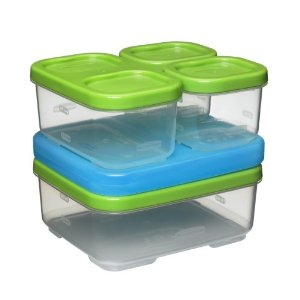
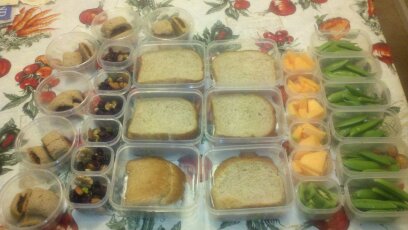
I found this Rubbermaid lunchblox kit.
That blue thing in the middle is an ice pack. They are durable, easily washable, sparkle when they are clean and look really cute. The kids like them better since they can grab one container to take out to recess.  A few of the con’s are It’s easier for the kids to lose lids or misplace them.
The lids also have potential to get yucky stuff trapped so you have to make sure to clean those out well. I also have so many little containers to wash. But it beats saran wrapping. I fill up a sink tub with hot soapy water and either me or the kids will chuck the containers inside.

I mainly use the Lunchblox kit for the fresh fruit and vegetables. I use smaller ziploc containers for the carb snacks. I have 1 box of sandwich baggies for the times I must use them (usually for half a cucumber or tomato), or the times my kids ask for extra snacks, but other than those few times, I don’t use them.

When making lunches I try to think of healthy foods that I know my kids will like, not what I hope they’ll like. I usually ask them “will you guys eat green beans if they were in your lunch?” Either they will answer excitedly or look at me like I was insane and yell “no way!” I also try to keep things the same for everyone. If I know all the kids will eat grapes, I’ll put grapes. But if two kids don’t like bananas, I won’t put bananas at all. But if it’s only one kid who has an aversion to that specific food I’ll make an exception. If I had to make different things for everyone, it would make things really hard for me. Plus, there is a greater chance for mess ups.

One time my daughter came home with two full containers of applesauce and said to me “I don’t even like applesauce!” Shortly after, my husband came home and said “I would like to speak with your quality control department please.” He came home with one full container of grapes. He ate the other. So yeah, mess ups happen. Especially because it’s the last chore of the night. Don’t judge!

Now the fun part!

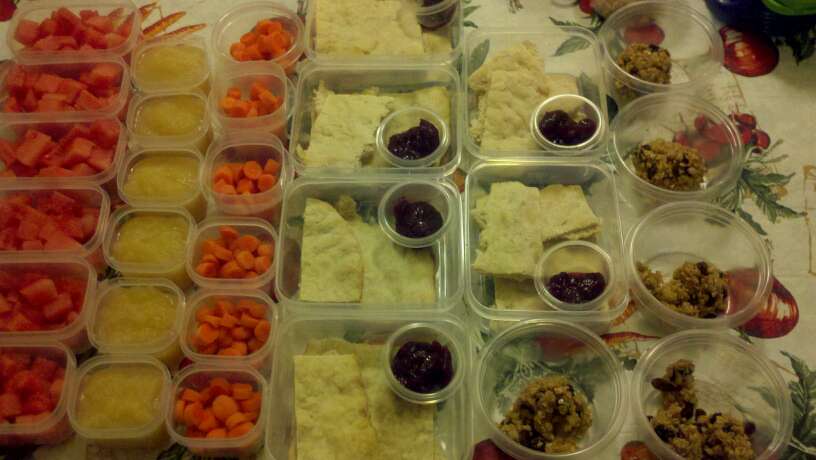
LUNCH #1

For the main dish I made flat bread (easiest and quickest to make when I didn’t have a chance to get bread) with a small cup of jelly for dipping. Next to that is homemade granola that the kids LOVED. Then it’s cut up baby carrots, applesauce and cut up watermelon.


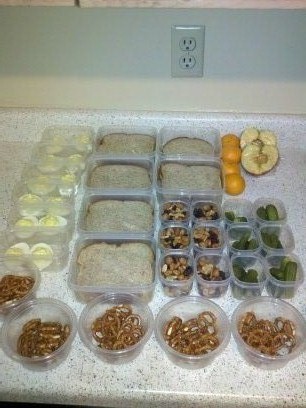
LUNCH #2


The main dish is tomato, cucumber and lettuce sandwich with a a little bit of mayo. The sides are dried fruit and nuts, pickles, deviled eggs, pretzels and a clementine or half an apple.

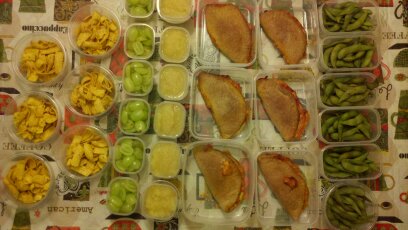
LUNCH #3

The main dish is a pizza pocket. (I take frozen dinner rolls out while I make dinner and let them defrost/rise until I am ready to make lunches. I then shape them into round circles, add sauce, cheese and mushrooms or olives and bake.) The sides are edamame beans, applesauce, grapes and corn chips.


Lunch #4 

The main dish is a cream cheese sandwich. Not that exciting but the kids could eat those every day. The sides are sugar snap peas, cantaloupe (one is kiwi since my oldest hates cantaloupe) dried fruit and nuts and homemade date bars. (It was my first attempt at these whole wheat bars and I had to agree with my kids that they sucked. I will not be making those again.)


These are just a few examples. I juggle things around, switch around the vegetable options and try to pick things my kids will like. I am not a dietician or a crazy health nut. I just know my kids and know their reaction to overloads of sugar. They crash. Big time! Plus, if I give them sweets as snacks, they are hungry not even an hour later and come home with crazy stomach pains. I used to send them with store bought granola bars but they didn’t feel well after. 


After starting to make lunches like these, my kids have been coming home with empty containers and started requesting healthy snacks first when they are home without even realizing it. Because of that I don’t buy a lot of the snacks I used to. It’s a lot healthier and makes them a lot happier. Sugar treats have become just that, treats.